Today I am reflecting on a reading from Jo Chrona‘s blog titled If Not Here, Then Where?, which is an excerpt from here book Wayi Wah! Indigenous Pedagogies: An Act for Reconciliation and Anti-Racist Education. This piece resonated with me as a future educator and challenged me to think critically about my responsibility in meaningfully integrating Indigenous ways of knowing into my teaching practice.
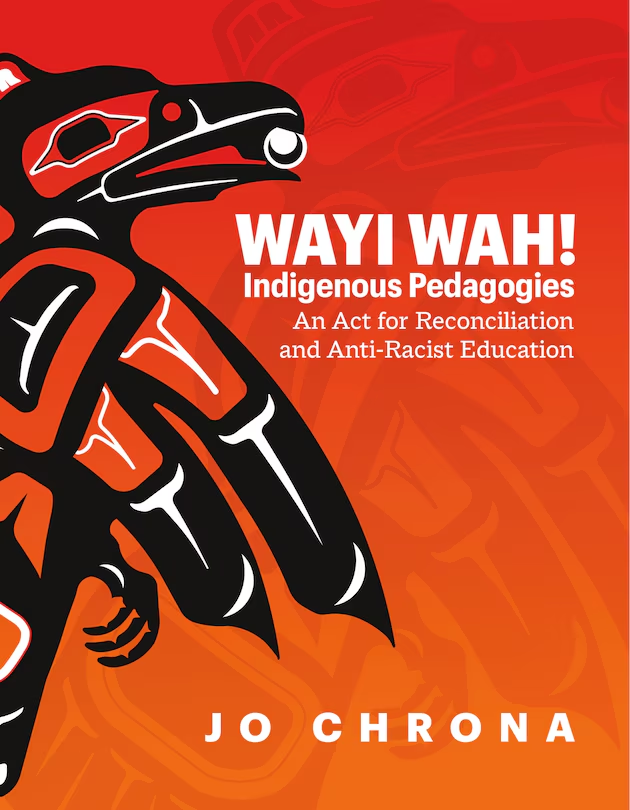
As I read Chrona’s post, I was reminded of the complete mindset shift I experienced last year after being introduced to Wayi Wah! in Shelley Balfour’s class. We were asked to select a short excerpt from any book to anchor a rich class discussion, and I chose the same passage from Chrona’s blog. Reading her words changed everything for me. It brought forward a sense of urgency and responsibility that I had not previously felt, that as a future teacher, this work is not optional or supplementary but essential.
Growing up, I had very limited exposure to Indigenous content and perspectives in throughout my schooling. My experience consisted of small, isolated, and out of context activities that lacked cultural understandings and connections to the Indigenous Peoples whose lands and communities we lived and learned on. When I entered the teaching program, I noticed how significantly the curriculum had shifted to include Indigenous ways of knowing and perspectives. While I supported these changes, I had not deeply reflected on what they meant for me personally and professionally. It was not until reading Jo’s words that I fully understood the why behind these curricular shifts.
When Chrona describes the ELA teacher’s moment of realization, that if the work is not being done in Canada, then it is not being done at all, I too shared that new understanding. I came to understand that teaching in Canada carriers a responsibility to bring to light not only the truth of Canada’s treatment of Indigenous Peoples but also the resurgence and revitalization of Indigenous knowledge systems. If educators fail to expose all learners to the rich, living knowledge of local Indigenous communities, then we risk perpetuating the colonial practices that marginalize and silence Indigenous ways of knowing. This realization helped me understand that celebrating diversity or multiculturalism alone is not enough. Meaningful Indigenization requires moving beyond those tokenistic, add-on, gestures towards authentic integration and respect for Indigenous perspectives and voices.
This reflection also connects to the ideas presented by Shelley Moore’s video on inclusion and classroom supports. Moore explains that education systems should work for the learners, we need to redesign our approaches to respond to learners’ needs, rather than expecting them to adapt to the system in place. Moore emphasizes the idea of providing students with the tools and strategies to increase their independence and agency in their unique learning journeys. This aligns with Chrona’s ideas, if we want all our learners to thrive, our classrooms must value diverse ways of thinking, learning, and knowing. Teaching students the tools and strategies to support their independence only works when those tools honor who our learners are and what they bring with them.
These ideas also directly tie to UVic Teacher Education Competency #6: Practise respect for all learners from all cultures, including, specifically, Indigenous learners. The specific mention of Indigenous learners, echoes Chrona’s call to action. If we want true inclusion for all our learners, then we need to create learning environments where Indigenous students see their identities, histories, and ways of knowing truly embedded in the classroom norms. For learners to take necessary risks in their learning, they need to feel safe, appreciated, and have a true sense of belonging. Whether there are Indigenous learners in your classroom or not, we need to make our classrooms responsive to Indigenous ways of knowing. If our goal as educators is to support students in becoming informed, responsible, citizens, then this work is essential. Respecting Indigenous perspectives and pedagogies is an important responsibility all us educators hold, and it is a necessary step toward creating a more equitable education system for all learners.
judi61
February 18, 2026 — 1:21 pm
Ryley,
I am pleased that you found the connection between Jo Chrona and Shelley Moore’s messages! Your words, ‘we need to redesign our approaches to respond to learners’ needs, rather than expecting them to adapt to the system in place’ is paramount to building up and with our learners so that we celebrate their skills and humanity! A collaborative model rings true when you fit all of this into the UDL model as well!
Taxa,
Judi