
My Literacy Station
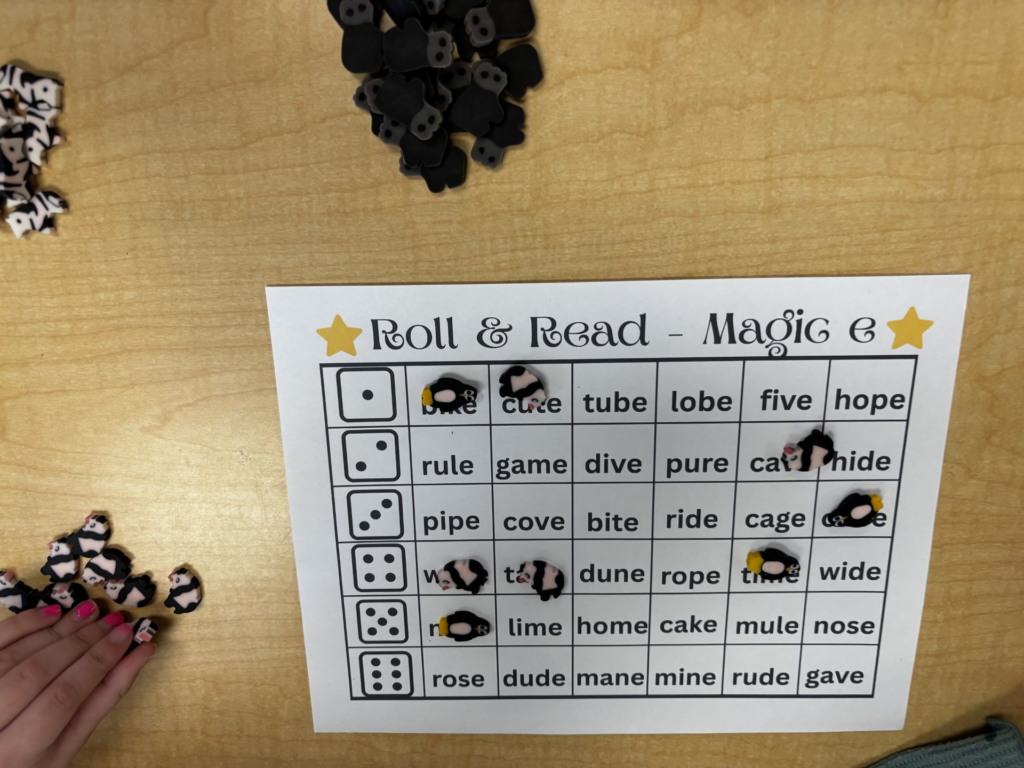
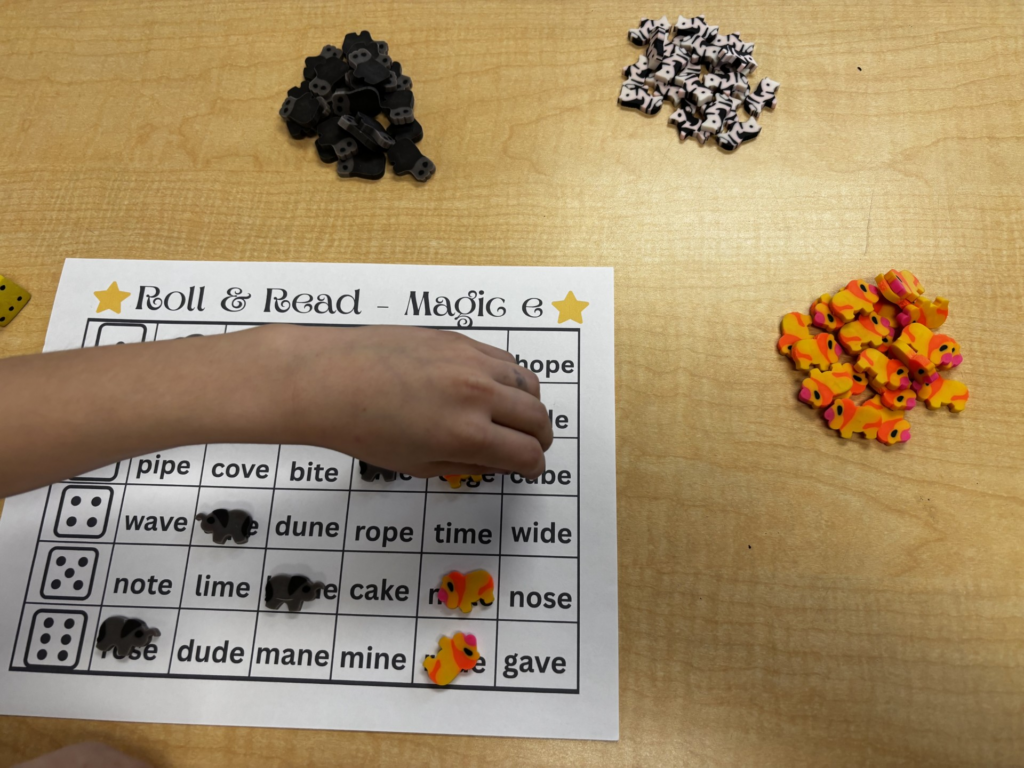
I worked with the Grade 1/2 students, focusing on the phonics concept of magic e! The activity I designed was a Roll & Read – Magic E game.
Supplies:
- 6-sided dice
- Gameboards
- Markers of different kinds (20 of each is great) – I used animal erasers, which the students loved 🙂
How it works:
- Create student pairs
- Give each student pair a gameboard, a die, and two sets of different markers
- Partners/teacher decides who goes first – I had the students play rock, paper, scissors which worked well 🙂
- Students take turns rolling the die
- The number rolled corresponds to a row on the gameboard
- The student selects a word to read from that row
- If the word is read correctly (after sounding it out), they mark the space with their marker
- If a word is unfamiliar, we sound it out together and leave it unmarked to revisit
- If a row is full, students continue rolling the die until a number comes up that has words available
- If you want to play competitively, the first student to make a vertical or horizontal line can be implemented (4-6 words in a line) – I left this out!
Reflection:
I created my activity to support students’ understanding of CVCE (consonant-vowel-consonant-e) words, to help them learn how adding an e changes the vowel from a short to a long sound. A key factor in the success of this station was the small group size. At most I had 4 students, so I was able to provide targeted support to both groups as needed through the more challenging words. When students struggled with certain words, I first covered up the magic e and we read the CVC word by sounding it out. Then we reviewed the class’s “bossy e” phonics rule: “e is bossy because it makes the vowel say it’s name.” During one rotation, I had a higher needs group where students needed more support decoding the words. Reflecting afterwards, I realized I should have grabbed a mini-whiteboard and pivoted my activity. Rather than having the students work in partners, I could have led a group mini-lesson. Students could have took turns rolling the dice and choosing a word to build and read together, the whiteboard could be used to show how to break apart the word, going over each of the letter sounds, before adding the e to show the final change in the sound. This would have made the activity more accessible, increased engagement and would have supported a deeper understanding of the what and why behind the vowel sound change. Overall it was a great learning experience and I had a lot of fun working with the class!
BC Curriculum – ELA Focus
Grade 1
- Big Idea: Playing with language helps us discover how language works
- Curricular Competencies: Use foundational concepts of print, oral, and visual texts
- Content: Language features, structures, and conventions – phonemic and phonological awareness
Grade 2
- Big Idea: Playing with language helps us discover how language works
- Curricular Competencies: Use developmentally appropriate reading, listening, and viewing strategies to make meaning
- Content: Language features, structures, and conventions – word patterns, word families