This week was all about story vines!!!
In our course textbook, Sometimes Reading is Hard by Robin Bright, she describes story vines as a method to build students’ reading fluency, collaboration, and speaking skills (2021, p.91). Story vines are braided strands of yarn or rope that have small artifacts, made out of various materials, to represent the sequence of the story events (Bright, 2021, p.91).
The steps to using story vines in schools are outlined on pages 91-92 (Bright, 2021):
- Choose a book -one that you love and know well <3
- Create an exemplar story vine
- Read the story aloud to your students
- Use your story vine to re-tell the story
- Students find their own story to turn into a story vine
- Students practice re-telling their stories using the language from the book with a partner
- Students share their story vines and re-tell the story to others
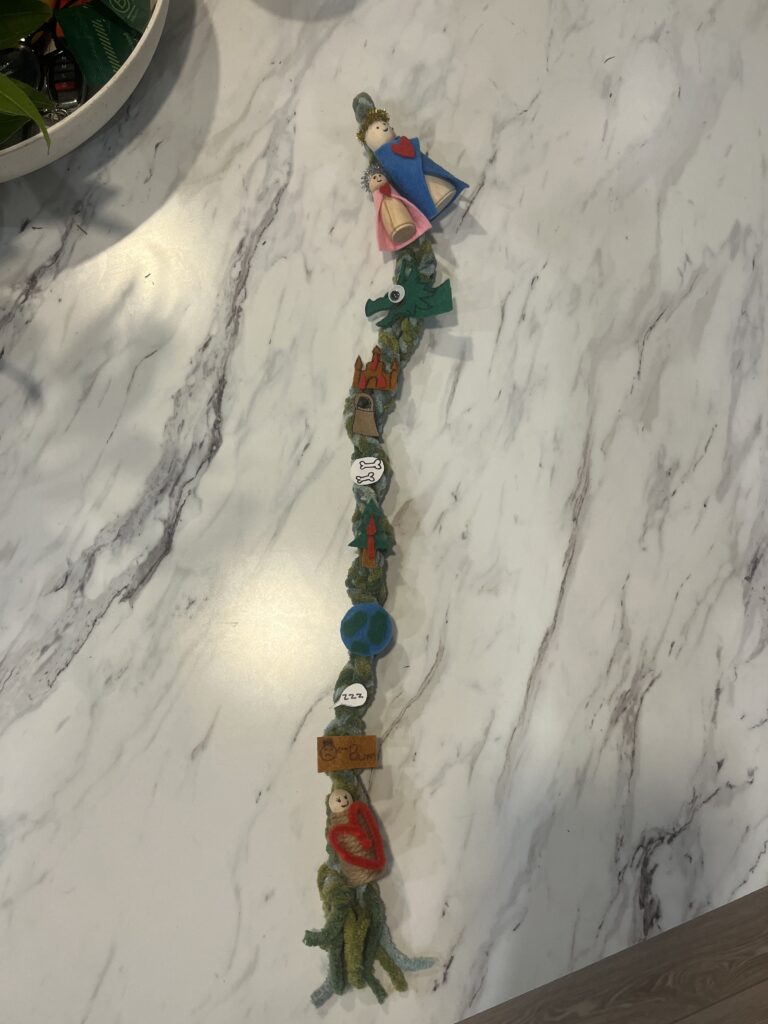
We had the opportunity to create our own story vines in class before working with the grade 2/3s from Gordon Terrace Elementary School. We had the choice of choosing a story we enjoyed or we were able to use Robert Munsch’s The Paper Bag Princess! I absolutely love this Munsch story and it is a childhood favourite of mine, so this was the option I went with. We had various materials to use to create our artifacts and it was such a fun process! I added a lot of artifacts to my story vine since I completed it at home and I wanted to be able to show the students lots of ideas of artifacts they could potentially create!
The elements I included:
- Prince Ronald and Princess Elizabeth in love (little hearts and fancy clothes/crowns)
- Dragon
- Castle on fire
- Paper bag (Elizabeth’s new outfit)
- Horses bones (how Elizabeth follows the Dragon to his cave)
- Tree on fire (Dragon burns down 150 forests!)
- World (Dragon flies around the world twice)
- Zzz’s (Dragon falls asleep thanks to Elizabeth outsmarting the dragon using reverse psychology)
- Sad prince with the word “BUM” pointing to him (after he insults Elizabeth for not “looking” like a princess)
- Elizabeth in her paper bag with a big heart (She learns that she doesn’t need a prince and she is happy loving herself!)
Making Story Vines at Huckleberry Books
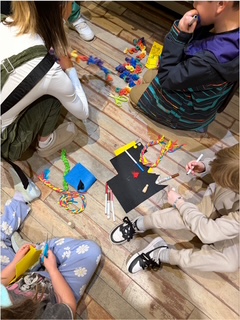
To celebrate Paper Bag Princess Day (a little early), we teamed up with the lovely local bookstore, Huckleberry Books, to do a story vine workshop with the grade 2/3 class. We first set-up the bookstore with tables full of supplies, hot glue guns, and reading nooks!
When the students arrived we broke into three groups to first read the story with the students. After, we showed them examples of story vines, and I showed my students the story vine I created to help them generate possible ideas for their own vines! The students then each got planning sheets to help them decide which artifacts they wanted to create to put on their story vines. In the meantime, some classmates and I helped to braid yarn for the students to save time so they could work on creating their artifacts! The students jumped into the creative process and it was a joy to see their visions come to life. The group of students I was working with was totally immersed in the process. Some needed a bit more support than others but all of us EKTEP students were eager to help bring their ideas to life and support with the hot glue guns. Once students finished creating, we had the students explain their story vines, going through their artifacts and using those to re-tell the story sequence of events 🙂

Re-Telling Stories with the Grade 2/3 Class
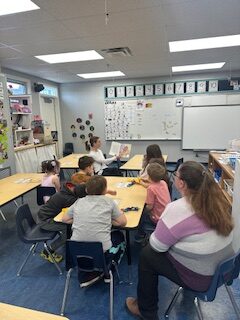
The following day we headed to Gordon Terrace Elementary to do a re-tell of the story. This time the grade 2/3 students were presenting their stories to the two kindergarten classes! In Bright’s textbook, she states that when students re-tell their stories to others it promotes their understanding of story sequencing, enhances their vocabulary, and links visuals with their stories (2021, p.91). Before we split into small groups we once again read the story as a class to ensure the students were well supported before their re-tells. Even when the classroom teacher was re-reading the book, the students showed that they had a very strong understanding of the following events and what was to come on the next page 🙂
When we got to the kindergarten class, the students shared their artifacts, and re-told the story of The Paper Bag Princess. The students did use language from the story to re-tell it, but I noticed that they focused mainly on describing the individual artifacts they had created rather than fully sequencing the events. However, with a group of three grade 2/3 students, we were able to cover almost all of the main story events so that the kindergarten students could understand the full story! This activity was definitely beneficial for reading comprehension, the students gained a much deeper understanding of the plot through constructing their own story vines. With a bit more explicit modelling, I think the re-telling could have been even more detailed, so that’s something I will ensure to do in my own classroom. After the re-telling we read more stories with the group of students from the classroom library 🙂 It was such a fun experience overall and I cannot wait to bring this activity into my own practicum this year integrating it with Science to tie in butterfly and plant lifecycles.
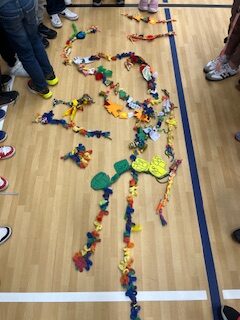
BC ELA Curriculum Connections Grade 2/3
- Big Idea: Language and story can be a source of creativity and joy.
- Curricular Competencies: Explore/Use oral storytelling processes. Recognize the structure and elements of story.
- Content: Elements of a story. Reading strategies. Oral language strategies.
Other ways to incorporate story vines
When I was looking up story vines online, I came across an article from CBC News about Manitoba teachers using story vines. The teachers in this article used story vines to bring to life traditional oral Indigenous stories such as the creation story. This is something I would love to do with my own class one day, even if a story is not traditionally written down, it can still be used to create a story vine. For example, when listening to the story, students could make small notes about what sticks out to them and that could be transformed into the artifact for the story vines. I think this would be a great way to embed the First Peoples Principles of Learning and Indigenous perspectives into the classroom.
I also read in the article that one teacher had their own personal story vine to represent their life. This would be accessible to all ages and also supports the First Peoples Principles that learning is embedded in memory, history, and story. Students love to share about their own lives and I think this would be a fun hands on way to get to know more about students, their interests, and experiences <3