
After reading The Cult of Pedagogy article about the different types of classroom rubrics, I found myself reflecting on the kind of assessment culture I want to create in my future classroom. The article explains that there are three different styles of rubrics – analytic, holistic, and single-point. Each one serves a purpose and understanding their differences has helped me to think more intentionally about assessment rubrics as a tool for learning, rather than strictly grading.
Holistic Rubrics
Holistic rubrics provide broad, overall descriptions of the student learning being assessed. The advantages of these rubrics are their efficiency in both creating and assessing student learning with. Teachers assess the student work and assign an overall grade based on the rubric. The downsides of these rubrics are that they do not provide much targeted feedback without additional explanations. Because of this, I see holistic rubrics as being best suited for testing students’ general understandings of concepts, to get a quick snapshot of their learning, as opposed to lengthier projects or complex skills.
Analytic Rubrics
Analytic rubrics are what I am most familiar with because of my own educational upbringing. They break down the learning into clear distinct criteria and levels, they are extremely structured, almost like a roadmap to success. The pros of these rubrics are they are clear for students to read and understand, they explicitly state what emerging, developing, proficient, and extending look like in relation to the learning outcomes. Another positive of these rubrics is that they allow teachers to score different aspects of student learning independently, allowing for quick assessment when scoring. The cons of this rubric are they are time consuming to create and again they do not provide descriptive targeted feedback to students, usually a checkmark or highlighted box is all the students get, or maybe an overall comment. I could see these rubrics being most useful when you are teaching specific skills, like essay writing or science demonstrations, teachers can point to which areas need more attention and which areas have been mastered.
Single-Point Rubrics
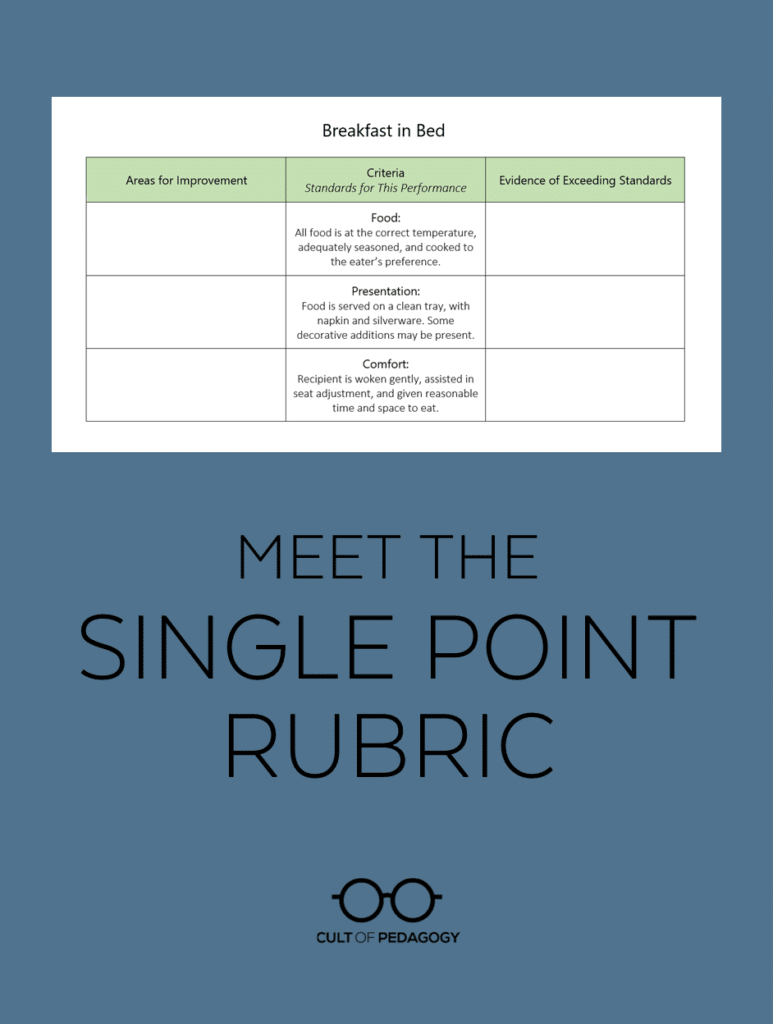
Single-point rubrics are the ones I feel most aligned with! They are similar to analytic rubrics but they only clearly describe the criteria for proficiency. They provide students with a concrete target to shoot for but do not box students into predefined levels, allowing them to be more creative in showing their learning. Also the feedback students get is very descriptive and targeted to their unique needs which I see as being the most useful to help students on their unique learning journeys. I love the idea Judi introduced in class for addressing strengths and weaknesses by using the language of “grows” and “glows.” Grows being the areas students can work on improving in, glows being the areas the students exceeded expectations in.
This format seems the most meaningful to me when assessing student learning. From my own personal experience I also see these rubrics as supporting a growth mindset for students. The rubric leaves the learning task more open to creativity, rather than simply checking the boxes for success, which I think more deeply supports the idea of promoting lifelong learning. I could see these rubrics being beneficial in any learning task!
Co-Creating Rubrics
Co-creating rubrics is something we explored in our own class. After exploring the idea of it, I see value in using this in my own teaching practice. It gives students a voice in their assessment criteria which allows students to take more ownership in their own learning. By involving the students’ voice in the learning assessment, they get to define what success looks like, with guidance, therefore becoming more accountable and invested in the learning itself. Rather than only working to achieve a grade, they work toward the criteria they helped outline. This promotes students’ metacognition and shifts assessment from something being done to students, to something being done alongside them. I see this process as being best suited to single-point rubrics, as it does not become redundant and allows learners to see the goal. I cannot wait to use this approach and help drive my students learning forward!
UVic Teacher Education Competency
In connecting this reflection to the UVic Teacher Education Competencies, two stand out to me in particular. The first is #11: Implement pedagogically context-appropriate sound practices linking assessment for/as/of learning, planning for learning, instructional strategies and approaches to engage all students in relevant and personalized learning. By utilizing single-point rubrics, I will be prioritizing descriptive, growth oriented feedback and setting a clear, high expectation target for all my learners. This supports student learning through personalized feedback and also allows learners more creativity with demonstrating their learning. Additionally, the process of co-creating assessments alongside my students makes assessment a tool for learning, not simply a tool for scoring. This allows learners to have a voice in shaping our learning, a stronger understanding of what success looks like, and allows them increased ownership to support their overall growth.
The second is #2: Develop a growth mindset demonstrated in collaboration with others. By using single-point rubrics and co-creating alongside students, it begins to naturally promote a growth mindset. It gives students room to extend their thinking in personalized ways, without the pressures of checking the boxes within the extending category criteria. By creating opportunities for students to co-design their assessments it also allows them more input and differentiation, shaping how students show their learning. I hope that these practices will allow my learners more confidence, voice, and choice in our classroom assessment and to see learning as a process over a checklist to conform to!
judi61
February 24, 2026 — 7:03 pm
Ryley,
Thank you for this post. Allowing student voice and choice with regards to co -creating rubrics is already a step in the right direction. Having students define what success looks like and helping them to navigate the criteria needed is a recipe for growth and self reflection. We must always look back at what was and look forward to what can be. How might we illuminate the possibilities of success in our learners? It is up to you to provide the spark!
Taxa,
Judi