
The UVic Teacher Competency I will be connecting this post to is #12 “Developing an understanding of how learners learn in order to cultivate effective learning environments.” This competency highlights the need for effective teachers to continuously analyze their teaching practices, both in the moment (reflexive) and post-experience (reflective). This post will highlight reflective practices by using a thinking model to reflect on a recent teaching experience I had.
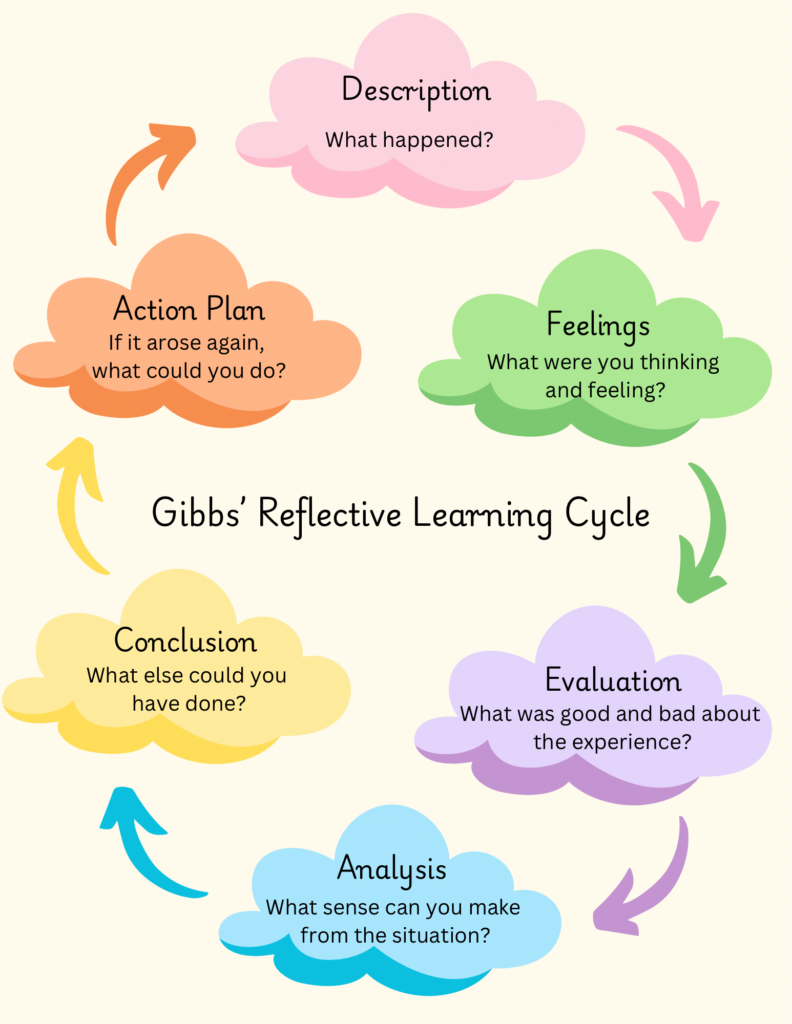
Last year, I was introduced to the Gibbs’ reflective learning cycle thinking!
Driscoll’s Model of Reflection
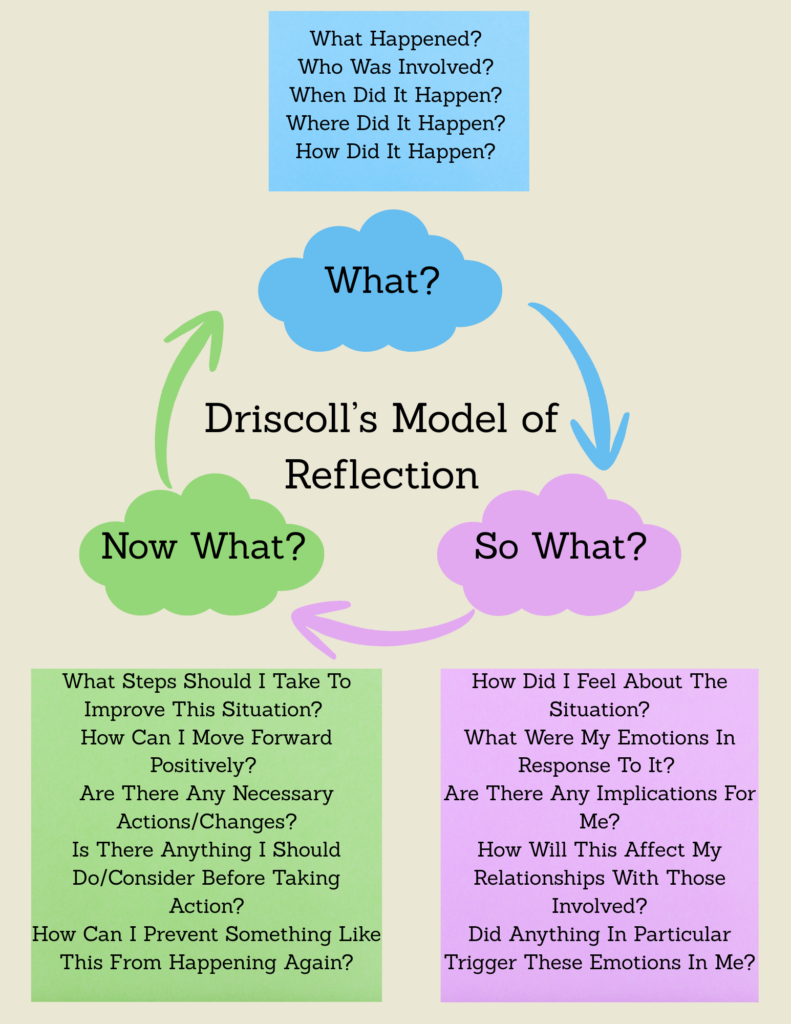
Recently in class I was introduced to a new thinking model, the Driscoll’s Model of reflection!
Comparisons:
- Both thinking models offer structured ways to reflect on situations while also being cyclical to promote ongoing learning from experiences. No matter which cycle is used for reflections, it allow teachers to analyze, improve, and adjust their practices in more responsive and pedagogically sound ways.
- The models include similar core elements – describing the events that occurred, taking account of emotional factors, addressing what could have been done, and making an action orientated plan for the next situation.
Contrasts:
- Gibbs is more detailed and complex in its reflective cycle; there are 6 delineated stages of reflection.
- Driscoll’s reflective cycle is broader; the 3 stages encapsulate many facets of the Gibbs cycle but are condensed into a more streamlined process.
- Gibbs is a great tool for complex situations that require significant reflection and a thorough breakdown of the situation to arrive at an action plan.
- Driscoll’s is a great model for quick reflections; it is less timely to reflect through the three stages and is a good day-to-day reflection tool for busy teachers.
My Thinking Model Reflection
The situation I am reflecting on is a lesson I recently taught in my practicum class. I will be using the Driscoll’s Model, as I have not yet had the chance to work with it yet and I would like to expand my reflective teaching toolkit!
What?
Last week, I co-taught a bucket filling social-emotional-learning (SEL) lesson with a classmate in our practicum Grade 1 and Grade 1-2 classes. We arrived at our practicum school and set up to teach our lesson first thing in the morning. The mini-lesson was taught for our assessment course and incorporated a variety of assessment strategies such as worksheets, observations, goal-setting, and self-assessments. We started the lesson by reading Have You Filled a Bucket Today? by Carol McCloud. As a class, we led the students through role-play scenarios, discussions, and worksheets about bucket dipping and bucket filling. The students grasped the concept well and were engaged throughout the whole lesson. Where things shifted was during the goal-setting assessment piece. We discussed setting classroom-focused bucket filling goals rather than outside of school goals, as it is anti-bullying month and we have noticed some challenging peer behaviors during our time in the classrooms. However, what we did not anticipate was that many of the students did not have exposure to goal-setting prior to our lesson. Because this was a mini-lesson, the goal-setting portion was brief, and many students created broad goals such as “be a good friend,” “kiss my dog,” or “help the teacher.” While these goals reflected positive intentions, they lacked specificity and measurability, which had been key factors behind the usefulness of using goal-setting for student learning in our prior research.
So What?
This experience was important because it highlighted the importance of not assuming prior knowledge when teaching metacognitive assessment skills, especially in younger primary grades. Although the students demonstrated strong understandings of bucket filling, they did not have much experience with goal-setting, which impacted their ability to create specific and measurable goals related to the learning outcomes. I was disappointed in my delivery of the goal-setting portion of the lesson because the students clearly needed more direct instruction, teacher modelling, and likely one-on-one support, including scribing, to engage in goal-setting at this level. While goal-setting is valuable for learning, I do not think a short mini-lesson is where it should be introduced for the first time. Even though many of the students’ goals were broad or unrelated to the classroom, they still reflected positive intentions related to filling others’ buckets, which was the learning intention for our lesson as a whole. This reminds me that even though the goal-setting did not go exactly as planned, the SEL goals were still achieved, which I see as a success. Overall, this experience reinforced the idea that scaffolding assessment tasks and being flexible in my expectations is important when working with young learners.
Now What?
As I continue to move forward into my practicum, I plan to use this learning experience as a valuable teaching opportunity. As I enter my 6-week practicum, I will continue to integrate goal-setting, but only after more explicit and scaffolded teaching of what goals are, how to make them specific and meaningful, and how to revisit and reflect on them over time. Rather than expecting students to independently set goals within a single lesson, I will model examples, co-construct class goals, and provide one-on-one guided conversations for personal goal-setting practice. Even at the primary level, goal-setting is a valuable learning tool that supports students in developing accountability and ownership over their learning. This experience has shown me that goal-setting is better used as an ongoing process rather than a one-time assessment task, and that expectations must remain accessible and developmentally appropriate for all learners in the classroom.
judi61
February 16, 2026 — 12:47 pm
Ryley,
Yes -as you mentioned regarding making assumptions regarding learners’ metacognition can be problematic! Unless you have been with these learners for a long enough time to ‘really’ know how they process new information, you cannot assume that they will transfer those skills either!
Co – constructing goals is a great way to start your learners to think about what they are collectively working towards and how they will get there.
Using the metaphor of a map and a journey helps with visuals too! (hence ‘Learning Journey’).
Thank you for the post and its connection to a competency!